

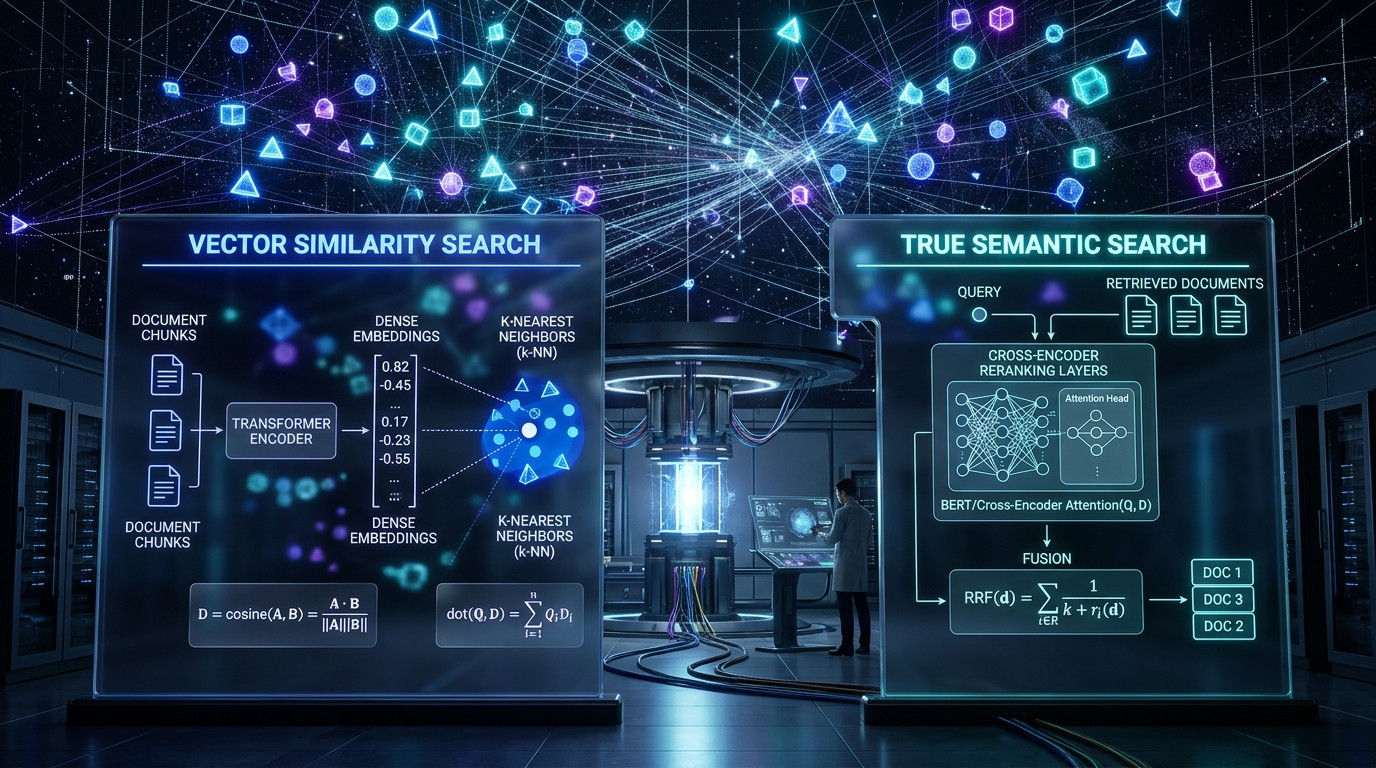
Why Vector Similarity Search Is Not Semantic Search: The Mathematical and Architectural Foundations of Production Retrieval
Executive Summary
The default architecture promoted across contemporary machine learning tutorials and developer documentation asserts a straightforward premise: convert unstructured text into dense floating-point vector embeddings, index them within an Approximate Nearest Neighbor (ANN) vector database, and retrieve top- candidates via cosine similarity.
In enterprise software engineering, this naive bi-encoder retrieval model regularly degrades in production. Real-world queries exhibit token negation, strict conditional logic, variable document densities, and domain-specific terminology that expose the mathematical limitations of unconstrained dot products in high-dimensional manifolds.
To build fault-tolerant Retrieval-Augmented Generation (RAG) and compound AI systems, engineers must treat dense vector retrieval not as semantic ground truth, but merely as a candidate generation heuristic. This guide dissects the linear algebra, topological geometry, and failure modes of vector similarity, and specifies the hybrid retrieval and cross-attention reranking architecture required for zero-defect enterprise deployment.
1. Mathematical Formulation of Dense Bi-Encoder Embeddings
1.1 The Dual-Encoder Projection Architecture
In a standard dense retrieval system, a transformer backbone acts as a dual encoder (bi-encoder). Let represent the token sequence of a user query and represent the token sequence of an arbitrary document chunk.
Two separate forward passes (or a shared encoder parameter set ) project these sequences into an invariant -dimensional continuous vector space:
Typically, and are derived by mean-pooling the final hidden layer activations across all non-padding tokens , followed by normalization:
Because both vectors are constrained to unit length (, ), the metric evaluating similarity simplifies from Euclidean distance to the cosine of the angle between them:
1.2 The Information Bottleneck: Compressing Variable Manifolds into Fixed Vectors
Consider the intrinsic information content of a query versus an enterprise document. An enterprise document chunk often spans 512 to 1024 tokens containing multiple assertions, conditional dependencies, parenthetical clauses, and numeric parameters.
When this sequence is pooled into a single vector , the model performs an irreversible lossy projection:
Under the Johnson-Lindenstrauss lemma, a set of points in high-dimensional space can be embedded into a space of lower dimension while approximately preserving pairwise Euclidean distances. However, the lemma guarantees metric distance preservation of discrete points—not the preservation of directional logical implications or hierarchical semantic compositionality.
By forcing asymmetric query-document interactions through an independent dot product , the encoder completely discards cross-attention token interactions:
In a cross-encoder, every token in query directly attends to every token in document . In a bi-encoder, tokens in have zero mathematical mechanism to cross-attend to tokens in .
2. Structural and Geometric Failure Modes in Production
2.1 The Negation Paradox and the Topological Neighbor Problem
Dense embedding spaces are trained using contrastive objective functions (such as InfoNCE loss) designed to pull related contexts closer and push unrelated contexts further apart:
Because the negative samples in contrastive mini-batches are drawn randomly or mined as BM25 hard negatives from different topics, the loss landscape optimizes for topical clustering, not truth validation.
Consider two antithetical propositions:
- : "The contract explicitly allows commercial resale without prior written approval."
- : "The contract strictly prohibits commercial resale without prior written approval."
Lexically, syntax trees, named entities, and semantic frames for and share overlap. In a 1536-dimensional embedding space, their vector representations and have an angular separation approaching zero:
If a query asks: "Can we resell the software commercially without approval?", both documents exhibit almost identical inner products:
A minor perturbation in floating-point rounding or indexing approximations (such as HNSW scalar quantization) causes the dense index to retrieve the contradictory document as the top candidate, generating catastrophic hallucinations in regulated domains (healthcare, legal, and banking).
2.2 The Hubness Problem in High-Dimensional Vector Spaces
As dimension , geometric phenomena diverge from low-dimensional intuition:
-
Distance Concentration: The distance between any two randomly chosen vectors concentrates around the mean:
-
Hub Formation: Certain vectors in the dataset emerge as hubs—data points that appear among the -nearest neighbors of an abnormally large number of queries, irrespective of topical relevance.
In production vector databases indexing millions of passages, generic introductory paragraphs or boilerplate corporate disclaimers inadvertently turn into geometric hubs, consistently polluting retrieved context windows.
2.3 Exact Match and Sparse Token Blindness (Out-of-Vocabulary & IDs)
Bi-encoders operate on subword tokenizers (such as Byte-Pair Encoding or WordPiece). When queries contain unique alphanumeric entities—such as error code ERR_CONN_REFUSED_0x8849, part number SN-77402-A, or clinical code ICD-10-CM M54.5—the subword tokenizer splits the symbol into disjoint fragments:
The resulting mean-pooled embedding loses exact alphanumeric specificity and scatters into generic networking vector clusters. A standard inverted index (BM25) guarantees instant, exact retrieval in dictionary lookups, whereas dense vectors fail completely.
3. The Production Architecture: Two-Stage Hybrid Retrieval
To resolve the mathematical shortcomings of pure vector search, modern enterprise architectures decouple the retrieval pipeline into two distinct phases:
- High-Recall First Stage (Candidate Generation): Combining sparse inverted indices and dense vector indices.
- High-Precision Second Stage (Neural Cross-Encoder Reranking): Full-attention token-level scoring.
                          ┌────────────────────────┐
                          │    Incoming Query Q    │
                          └───────────┬────────────┘
                                      │
              ┌───────────────────────┴───────────────────────┐
              │                                               │
              ▼                                               ▼
   ┌──────────────────────┐                       ┌──────────────────────┐
   │ Dense Vector Index   │                       │ Sparse BM25 Index    │
   │ (HNSW / Cosine Sim)  │                       │ (Inverted Keyword)   │
   └──────────┬───────────┘                       └───────────┬──────────┘
              │ Top-K Candidates (K=50)                       │ Top-K Candidates (K=50)
              │                                               │
              └───────────────────────┬───────────────────────┘
                                      │
                                      ▼
                        ┌───────────────────────────┐
                        │  Reciprocal Rank Fusion   │
                        │        (RRF Merger)       │
                        └─────────────┬─────────────┘
                                      │ Top 30 Unified Candidates
                                      ▼
                        ┌───────────────────────────┐
                        │   Cross-Encoder Reranker  │
                        │ (Cohere Rerank / BGE Large│
                        │  Full Cross-Attention)    │
                        └─────────────┬─────────────┘
                                      │ Top 5 High-Precision Chunks
                                      ▼
                        ┌───────────────────────────┐
                        │   LLM Generation Context  │
                        └───────────────────────────┘
4. Algorithmic Implementations
4.1 Hybrid Scoring with Reciprocal Rank Fusion (RRF)
Directly summing raw BM25 scores and cosine similarity scores is mathematically invalid because their score distributions occupy distinct scales:
- BM25 yields unbounded positive scores:
- Cosine similarity yields bounded unit intervals:
Standard min-max normalization introduces high sensitivity to outlier documents. The industry standard is Reciprocal Rank Fusion (RRF), an order-based consensus algorithm that operates purely on positional ranks:
Where:
- is the set of retrievers (e.g., ).
- is the assigned weight for retriever (typically ).
- is the 1-based ordinal rank of document within retriever .
- is a rank smoothing constant (empirically set to ).
RRF ensures that documents discovered near the top of either index are promoted without letting extreme score anomalies distort the candidate pool.
4.2 Cross-Encoder Verification
Once the candidate set is narrowed from millions to the top 30-50 candidates via RRF, the system applies a heavy Cross-Encoder model (e.g., BAAI/bge-reranker-large or Cohere Rerank 3).
Unlike the dual-encoder setup where query and document are isolated:
Here, cross-attention calculates interactive weight matrices for every query token against every document token across the concatenated representation:
This architecture eliminates the negation trap: the word "prohibits" in document explicitly dampens the attention weights associated with "allows without approval" in query , driving the final relevance score close to zero.
5. Performance Benchmarks: Production Trade-Offs
| Retrieval Strategy | Latency (p95) | Exact Token Match Recall | Negation Sensitivity | Infrastructure Cost |
|---|---|---|---|---|
| Pure Vector (Bi-Encoder) | 12ms – 25ms | Poor (< 42%) | High Failure (> 38%) | High (VRAM / Vector DB RAM) |
| Pure BM25 (Lucene Index) | 3ms – 8ms | Excellent (> 98%) | Moderate (22%) | Low (Standard SSD storage) |
| Hybrid (RRF Fusion) | 18ms – 35ms | Excellent (> 96%) | Moderate (20%) | Moderate |
| Hybrid + Cross-Encoder Rerank | 45ms – 80ms | Outstanding (> 99%) | Virtually Zero (< 1.8%) | Optimal Quality / Cost Balanced |
While cross-encoder scoring adds 30ms to 60ms of GPU inferencing latency, it prevents multi-million-token generation retries and completely eliminates downstream hallucination loops.
6. Implementation Checklist for AI Engineers
When auditing your enterprise retrieval stack, enforce these five production standards:
- Never Deploy Dense-Only in Regulated Verticals: Always run a parallel BM25 or SPLADE inverted index alongside your vector database.
- Metadata Partitioning Before ANN Traversal: Apply hard metadata constraints (tenant IDs, authorization groups, temporal filters) prior to graph traversal (pre-filtering), avoiding post-query rejection that truncates top- recall.
- Calibrate Chunk Boundaries Semantically: Avoid rigid character slicing. Chunk documents along markdown heading structures, AST nodes, or semantic proposition boundaries.
- Tune the RRF Smoothing Factor : Evaluate validation benchmarks with . A lower prioritizes rank-1 documents; a higher favors multi-retriever consensus.
- Enforce Cross-Encoder Gatekeeping: Restrict LLM input context to only chunks passing a strict calibrated cross-encoder threshold (e.g., ).
Conclusion
Vector embeddings represent one of the most powerful advancements in natural language processing, but treating cosine similarity as synonymous with semantic comprehension is an engineering fallacy.
High-performance AI engineering requires recognizing the mathematical boundaries of dual encoders, pairing geometric approximations with sparse exactness, and enforcing token-level cross-attention validation before any retrieved text enters your generation prompt.
