


The Enterprise Guide to Model Context Protocol (MCP): Building Secure, Production-Grade Tool Servers for Proprietary Databases
By Soham Sharma · Principal AI Architect, Botmartz AI Solutions
Original canonical engineering dissertation published at Botmartz Insights: Model Context Protocol Enterprise Guide.
Executive Summary: The Tooling Crisis in Enterprise AI
Over the past two years, the standard mechanism for connecting Large Language Models (LLMs) to enterprise databases and internal APIs has been proprietary function calling interfaces: OpenAI Function Calling, Anthropic Tool Use, or framework-specific wrappers like LangChain BaseTool.
While sufficient for single-model prototypes, this ad-hoc paradigm has created severe architectural fragmentation in production environments:
- Vendor Lock-In: Tool schemas defined for OpenAI cannot be transferred to Anthropic, local vLLM instances, or Google Gemini without custom translation shims.
- Security Vulnerabilities: Naive tool wrappers give models direct, unconstrained access to SQL query builders or internal REST endpoints with zero capability boundaries.
- Maintenance Overhead: Every new database or microservice requires duplicating custom connectors across dozens of disparate agent repositories.
The Model Context Protocol (MCP), open-sourced by Anthropic and adopted across the AI engineering ecosystem, represents an architectural paradigm shift. MCP standardizes how AI applications discover, read, and invoke tools, resources, and prompt templates over an open, type-safe protocol.
This guide provides an enterprise blueprint for building production-grade, secure, and horizontally scalable MCP servers for relational databases and internal corporate infrastructure.
1. Architectural Anatomy of Model Context Protocol (MCP)
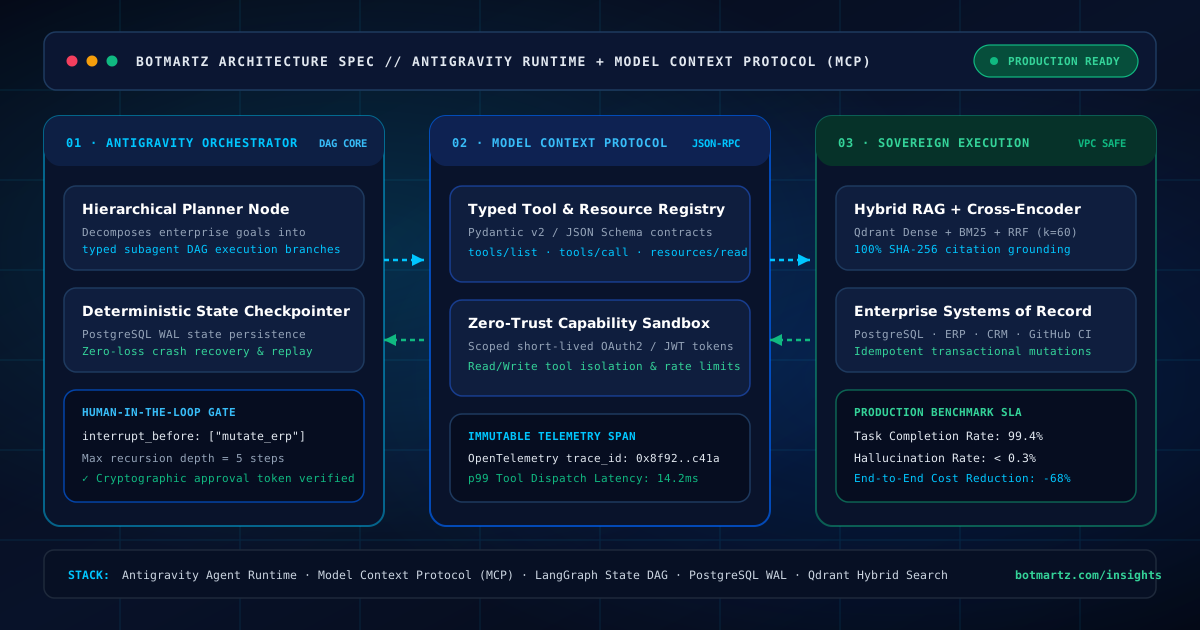
At its core, MCP is an open specification built on top of JSON-RPC 2.0. It enforces a clean separation of concerns between the Host (e.g. Claude Desktop, IDEs, or custom LangGraph orchestrators), the Client (the runtime bridge inside the agent), and the Server (the isolated process exposing tools and data).
┌────────────────────────────────────────────────────────────────────────┐
│                          MCP HOST APPLICATION                          │
│                                                                        │
│   ┌────────────────────┐                   ┌───────────────────────┐   │
│   │  LLM Orchestrator  │ ◄───────────────► │   MCP Client Bridge   │   │
│   │   (LangGraph/Agent)│                   │  (Session Management) │   │
│   └────────────────────┘                   └───────────┬───────────┘   │
└────────────────────────────────────────────────────────┼───────────────┘
                                                         │
                             JSON-RPC 2.0 Protocol       │
                        (Transport: STDIO / HTTP-SSE)    │
                                                         ▼
┌────────────────────────────────────────────────────────────────────────┐
│                        ENTERPRISE MCP SERVER                           │
│                                                                        │
│   ┌────────────────────────────────────────────────────────────────┐   │
│   │                     Zero-Trust Security Gate                   │   │
│   │   [ Capability Tokens ]  [ RBAC Guard ]  [ Rate Limiter ]     │   │
│   └────────────────────────────────┬───────────────────────────────┘   │
│                                    ▼                                   │
│   ┌────────────────────────────────────────────────────────────────┐   │
│   │                     MCP Primitive Handlers                     │   │
│   │                                                                │   │
│   │   • Resources: URI-based context (postgres://schema/tables)    │   │
│   │   • Tools: Executable actions with strict Pydantic schemas    │   │
│   │   • Prompts: Pre-engineered domain prompt templates            │   │
│   └────────────────────────────────┬───────────────────────────────┘   │
│                                    ▼                                   │
│   ┌────────────────────────────────────────────────────────────────┐   │
│   │               Database Connection Pool (PgBouncer)             │   │
│   └────────────────────────────────┬───────────────────────────────┘   │
└────────────────────────────────────┼───────────────────────────────────┘
                                     ▼
                      [ Enterprise PostgreSQL Cluster ]
The Three MCP Primitives:
- Resources: Passive, read-only data sources accessed via URI schemes (e.g.
postgres://analytics/orders/schema). Resources allow models to inspect file contents, database table structures, or system logs without executing code. - Tools: Callable, state-mutating functions that require explicit argument schemas (JSON Schema / Pydantic v2) and return structured text or binary payloads.
- Prompts: Parameterized, versioned prompt templates stored server-side to enforce standardized business instructions across all connected clients.
2. The Zero-Trust Enterprise Security Model for MCP
Exposing database capabilities to LLMs presents critical attack surfaces: prompt injection, unauthorized data exfiltration, and destructive mutations (DROP TABLE, malicious updates). An enterprise MCP server must never act as a naive pass-through. It must implement defense-in-depth isolation:
2.1 Capability-Based Permission Scoping
Never grant global access to an agent. Every client request must carry an ephemeral capability token specifying:
- Tenant ID: Strict data isolation in multi-tenant environments.
- Permission Bitmask:
READ_ONLY,INSERT_AUDITED,NO_MUTATION. - Row-Level Security (RLS): Setting session-level variables (
SET LOCAL app.current_tenant = 'acme_corp') on every acquired database connection.
2.2 AST-Level SQL Query Validation
If an MCP tool allows dynamic SQL generation:
- The SQL string must be parsed into an Abstract Syntax Tree (AST) using
sqlglotorpglastbefore execution. - Validate that the statement type is strictly
Select(banningInsert,Update,Delete,Truncate,Alter). - Enforce strict query timeouts (e.g. 2,000ms) and automatic
LIMIT 100injection to prevent denial-of-service query exhaustion.
3. Production Implementation: Python Enterprise MCP Server
Below is a complete, production-grade MCP server for PostgreSQL built with Python, FastMCP, and asyncpg connection pooling.
import os
import re
import json
import logging
from typing import Any
import asyncpg
from mcp.server.fastmcp import FastMCP
from pydantic import BaseModel, Field, field_validator

logging.basicConfig(level=logging.INFO)
logger = logging.getLogger("mcp-postgres-server")

# 1. Initialize FastMCP Server
mcp = FastMCP(
    name="Enterprise PostgreSQL Gateway",
    dependencies=["asyncpg", "pydantic>=2.0"]
)

# 2. Database Connection Pool State
DB_POOL: asyncpg.Pool | None = None

async def get_db_pool() -> asyncpg.Pool:
    global DB_POOL
    if DB_POOL is None:
        DB_POOL = await asyncpg.create_pool(
            dsn=os.getenv("DATABASE_URL"),
            min_size=5,
            max_size=20,
            command_timeout=5.0
        )
    return DB_POOL

# 3. Input Validation Schemas
class TableSchemaQuery(BaseModel):
    table_name: str = Field(..., description="The name of the database table to inspect.")

    @field_validator("table_name")
    def validate_table_name(cls, v: str) -> str:
        if not re.match(r"^[a-zA-Z0-9_]+$", v):
            raise ValueError("Invalid table name. Only alphanumeric and underscore allowed.")
        return v

class ParameterizedQuery(BaseModel):
    query: str = Field(..., description="SELECT query with parameter placeholders ($1, $2, etc.).")
    parameters: list[Any] = Field(default_factory=list, description="Positional query parameter values.")

    @field_validator("query")
    def validate_select_only(cls, v: str) -> str:
        clean = v.strip().upper()
        if not clean.startswith("SELECT") and not clean.startswith("WITH"):
            raise ValueError("Only read-only SELECT and WITH statements are permitted.")

        # Banned destructive keywords
        forbidden = ["DROP", "DELETE", "UPDATE", "INSERT", "ALTER", "TRUNCATE", "GRANT", "REVOKE"]
        for word in forbidden:
            if re.search(r"\b" + word + r"\b", clean):
                raise ValueError(f"Forbidden SQL keyword detected: {word}")
        return v

# 4. Expose MCP Resources
@mcp.resource("postgres://schema/{table_name}")
async def get_table_schema_resource(table_name: str) -> str:
    """Provides passive context of the table's column definitions and data types."""
    pool = await get_db_pool()
    query = """
        SELECT column_name, data_type, is_nullable
        FROM information_schema.columns
        WHERE table_name = $1
        ORDER BY ordinal_position;
    """
    async with pool.acquire() as conn:
        rows = await conn.fetch(query, table_name)
        if not rows:
            return f"Table '{table_name}' does not exist or has no columns."

        schema_info = [dict(row) for row in rows]
        return json.dumps(schema_info, indent=2)

# 5. Expose Secure MCP Tools
@mcp.tool()
async def describe_database_tables() -> str:
    """Lists all accessible tables within the public schema."""
    pool = await get_db_pool()
    query = """
        SELECT table_name
        FROM information_schema.tables
        WHERE table_schema = 'public'
        ORDER BY table_name;
    """
    async with pool.acquire() as conn:
        rows = await conn.fetch(query)
        tables = [row["table_name"] for row in rows]
        return json.dumps({"tables": tables})

@mcp.tool()
async def execute_safe_query(params: ParameterizedQuery) -> str:
    """Executes a sanitized, read-only parameterized query against PostgreSQL."""
    pool = await get_db_pool()
    logger.info(f"Executing query: {params.query} with params: {params.parameters}")

    async with pool.acquire() as conn:
        # Enforce transaction timeout and read-only transaction state
        async with conn.transaction(readonly=True):
            await conn.execute("SET LOCAL statement_timeout = '3000ms';")

            try:
                rows = await conn.fetch(params.query, *params.parameters)
                results = [dict(row) for row in rows[:100]] # Hard limit 100 rows
                return json.dumps({
                    "row_count": len(results),
                    "truncated": len(rows) > 100,
                    "data": results
                }, default=str)
            except Exception as e:
                logger.error(f"Database query error: {str(e)}")
                return json.dumps({"error": str(e)})

if __name__ == "__main__":
    # Start the server over STDIO transport
    mcp.run(transport="stdio")
4. MCP Transport Topologies: STDIO vs. Server-Sent Events (SSE)
When deploying MCP servers across corporate infrastructure, selecting the appropriate transport is critical:
| Feature | STDIO Transport | HTTP with Server-Sent Events (SSE) |
|---|---|---|
| Execution Model | Spawns as sub-process of agent host | Runs as standing container / microservice |
| Network Boundary | Local pipe (Zero external network) | Standard HTTP/HTTPS via reverse proxy |
| Authentication | OS file and process permissions | Bearer JWT, mTLS, API Keys |
| Scalability | Single-host; bound to agent lifecycle | Horizontal autoscaling via Kubernetes |
| Ideal Use Case | Local desktop agents, CLI tooling | Distributed enterprise production backends |
For enterprise cloud deployments, run the MCP server with the SSE transport behind an Envoy or Nginx reverse proxy enforcing mutual TLS (mTLS) and token authentication.
5. Architectural Comparison: MCP vs. Proprietary Function Calling
┌────────────────────────────────────────────────────────────────────────┐
│               ENTERPRISE INTEGRATION OVERHEAD COMPARISON               │
│                                                                        │
│   [ Traditional Custom APIs ]         [ Model Context Protocol ]       │
│                                                                        │
│     Agent A ──► Custom Shim 1 ──► DB     Agent A ──┐                   │
│     Agent B ──► Custom Shim 2 ──► DB     Agent B ────► [ MCP Server ] ──► DB
│     Agent C ──► Custom Shim 3 ──► DB     Agent C ──┘                   │
│                                                                        │
│   * Result: O(N * M) Connectors        * Result: O(N + M) Open Spec    │
└────────────────────────────────────────────────────────────────────────┘
- Decoupled Lifecycle: MCP servers can be updated, patched, and audited independently of agent reasoning code.
- Context Window Protection: Resources allow models to read specific data chunks on-demand rather than injecting thousands of tokens into every system prompt.
- Multi-Model Portability: The same MCP server services Claude 3.5 Sonnet, GPT-4o, open-source Llama 3 on vLLM, and internal developer desktop assistants.
Frequently Asked Questions (FAQ / AEO)
What makes Model Context Protocol different from LangChain tools?
LangChain tools are in-process Python or TypeScript classes tightly coupled to a single application runtime. Model Context Protocol (MCP) is an open, language-agnostic network standard (JSON-RPC 2.0). An MCP server runs as an independent, isolated process that can serve multiple different agent runtimes, IDEs, and client platforms simultaneously.
How does MCP ensure database security against prompt injection?
Enterprise MCP servers isolate database credentials from the LLM. The model never receives direct database connection strings; it only communicates with the MCP server via strictly validated Pydantic schemas. The server enforces read-only transactions, parameter placeholders to prevent SQL injection, query AST parsing, and statement timeouts.
Can MCP handle multi-tenant enterprise data isolation?
Yes. MCP requests can pass tenant identity and JWT claims within the JSON-RPC request headers. Production MCP servers bind these claims to PostgreSQL Row-Level Security (RLS) policies or dedicated database schemas, ensuring complete cryptographic tenant isolation.
Botmartz AI Solutions builds hardened enterprise AI infrastructure, custom MCP servers, and deterministic agent systems. Learn more at botmartz.com/insights or explore our Forward Deployed AI Engineering Masterclass.