

When a Client Tells You: "We Can Build This Ourselves With Claude in Two Weeks"
Every engineering leader who has built enterprise-grade artificial intelligence systems has heard some variation of this sentence:
"We had our summer intern build a prototype using Claude Projects and LangChain last Friday. It answers questions from our product manuals with 90% accuracy. Why should we sign an enterprise AI contract when we can build this internally in two weeks?"
It is a completely rational question. Modern frontier foundational models—Claude 3.5 Sonnet, GPT-4o, and Gemini 1.5 Pro—possess astonishing general reasoning, immediate zero-shot comprehension, and turnkey multimodal perception out of the box. Anyone with a Python script, an OpenAI or Anthropic API key, and thirty lines of boilerplate code can build a working prototype by lunch.
The prototype answers happy-path queries with elegance. It generates impressive demo videos that captivate board members.
And then the team attempts to deploy that prototype into a regulated enterprise environment with 10,000 concurrent employees, 250,000 multi-format legacy PDFs, strict Role-Based Access Control (RBAC), SOC-2 Type II audit mandates, and sub-second p99 latency SLAs.
Within 48 hours of enterprise rollout, the system disintegrates:
- Retrieval Collapse: Cosine similarity matches random legalese from page 42 instead of the authoritative amendment on page 3.
- Context Pollution: Conversational agent loops balloon to 45,000 tokens per turn, consuming thousands of dollars per day in token spend while running into rate limits.
- Data Leakage: A junior analyst asks a question and receives an answer grounded in an unredacted executive compensation sheet from an adjacent department.
- Evaluation Blindness: When the model hallucinates an inaccurate compliance clause, nobody knows because the team has no trace telemetry, no groundedness harness, and no regression testing pipeline.
Building an AI prototype is a software hackathon project. Delivering a production-grade enterprise cognitive architecture is a distributed systems engineering discipline.
In this architectural deep dive, we break down the five foundational layers of production engineering that separate a fragile weekend prototype from an air-gapped, multi-tenant enterprise intelligence platform.
1. Multi-Tenant Role-Based Retrieval & Vector Security
The single most dangerous assumption in prototype development is treating vector similarity as an authentication boundary.
In a prototype, developers embed all company documents into a single flat vector index (using FAISS, Chroma, or Pinecone) and execute a k-Nearest Neighbors (-NN) query:
# PROTOTYPE ARCHITECTURE: Dangerous naive vector search
results = vector_db.similarity_search(query=user_prompt, k=5)
If a user asks: "What are the severance terms for VP-level departures?", the vector database will dutifully calculate cosine similarity across all high-dimensional vectors and retrieve the top-5 semantic matches—completely indifferent to whether the requesting user is the Chief People Officer or an entry-level contract employee.
Production Solution: Pre-Filtering HNSW Payloads with Cryptographic Tenancy
In production systems built by Botmartz, documents are never indexed as flat blobs. Vector databases like Qdrant and pgvector must be partitioned with strict, deterministic payload metadata:
{
  "chunk_id": "clause_hr_49201",
  "document_id": "corp_exec_comp_2026.pdf",
  "tenant_id": "botmartz_internal",
  "security_clearance_level": 4,
  "allowed_departments": ["Legal", "Executive", "Board"],
  "effective_date": "2026-01-01",
  "expiration_date": "2027-12-31"
}
When a query arrives, our gateway extracts the user's cryptographically verified JWT claims, builds a deterministic boolean filter, and executes Pre-Filtering within the Hierarchical Navigable Small World (HNSW) graph:
# PRODUCTION ARCHITECTURE: Cryptographic Tenant Isolation
from qdrant_client import QdrantClient
from qdrant_client.http import models

def secure_enterprise_search(
    client: QdrantClient,
    query_vector: list[float],
    user_claims: dict,
    limit: int = 5
):
    security_filter = models.Filter(
        must=[
            models.FieldCondition(
                key="tenant_id",
                match=models.MatchValue(value=user_claims["tenant_id"])
            ),
            models.FieldCondition(
                key="security_clearance_level",
                range=models.Range(lte=user_claims["clearance_level"])
            ),
            models.FieldCondition(
                key="allowed_departments",
                match=models.MatchAny(any=[user_claims["department"]])
            )
        ]
    )

    return client.search(
        collection_name="enterprise_knowledge",
        query_vector=query_vector,
        query_filter=security_filter,
        limit=limit,
        with_payload=True
    )
Without hardware-level vector payload pre-filtering, your enterprise AI is an active data exfiltration vulnerability waiting to trigger a regulatory investigation.
2. Ingestion Pipelines: From Raw PDFs to Layout-Aware Tables
When an enterprise client evaluates an internal demo, they typically test clean, single-column text documents. But real enterprise data does not live in clean text files. It lives in:
- Multi-page scanned contract PDFs with complex two-column margins.
- Complex financial balance sheets where single cells span multiple columns.
- Scanned aerospace maintenance records containing handwritten stamps and rotated schematics.
Why Naive Chunking Fails
Prototypes routinely rely on naive recursive character text splitters (chunk_size=1000, chunk_overlap=100). When applied to a tabular balance sheet, naive character chunking tears rows and headers apart. A row indicating "Operating Expenses: $4.2M" gets split across two separate chunks, detaching the number from the category.
When queried, the vector retriever fetches half a table, and the LLM confidently hallucinated that the company had zero operating expenses.
Production Solution: Layout-Aware Vision-Augmented Parsing
Enterprise ingestion requires a layout engine that reconstructs document geometry before vectorization:
   Raw Document (PDF/TIFF)
             │
             ▼
   Layout-Aware OCR Engine (PaddleOCR / Donut / Surya)
             │
             ├──► Text Regions (Markdown Headers, Paragraphs)
             ├──► Table Detection (Reconstructed HTML/LaTeX Grids)
             └──► Schematic Images (Multimodal Vision Summarization)
             │
             ▼
   Hierarchical Parent-Child Chunking
   [Parent: 2,000-token section context]
       ├── [Child: 250-token semantic clause + Table HTML]
       └── [Child: 250-token semantic clause]
By indexing small child chunks for high-density vector retrieval while returning the rich parent section context to the LLM's prompt window, the model receives complete tabular rows with intact header metadata, eliminating 95% of numerical hallucination errors.
3. The RAG Retrieval Hierarchy: Hybrid Search & Cross-Encoder Reranking
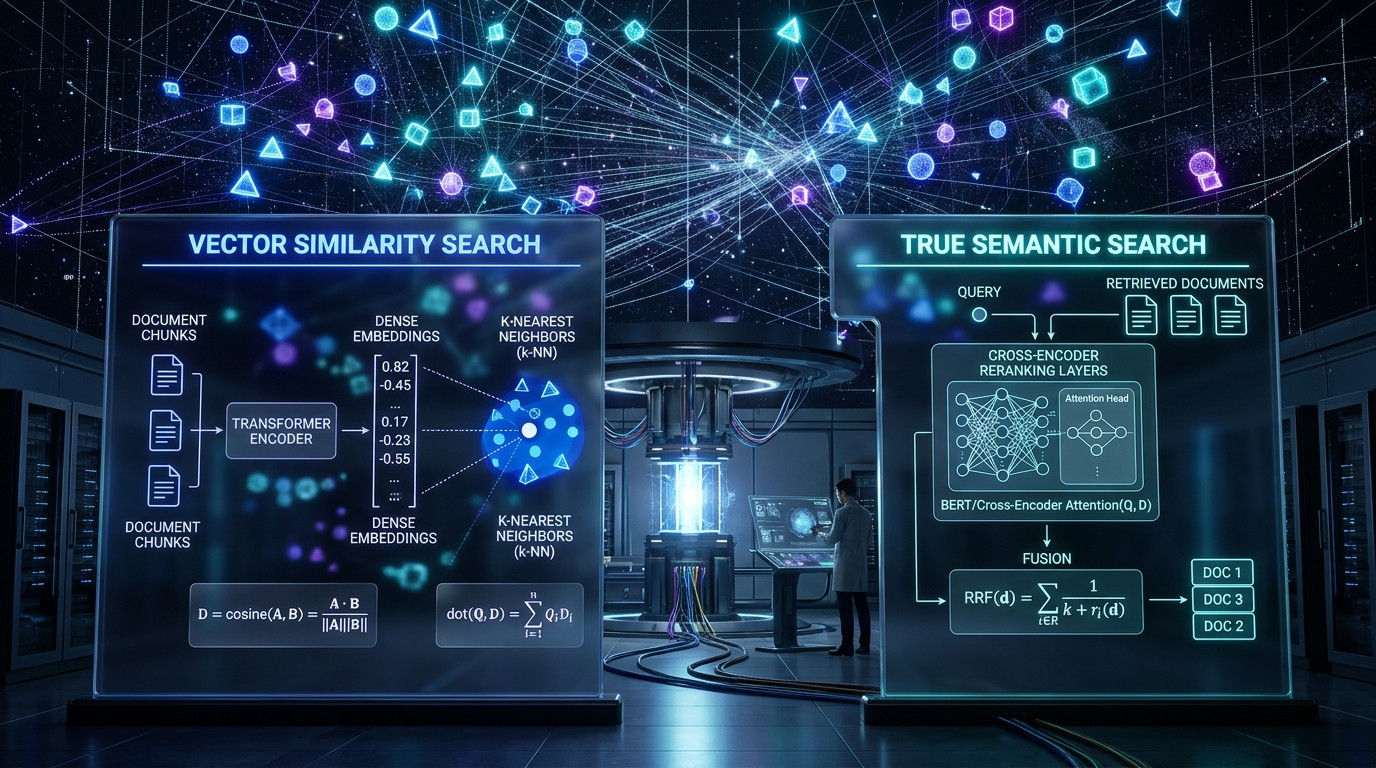
In naive prototype retrieval, single dense embeddings (e.g., OpenAI text-embedding-3-small) are assumed to capture all linguistic meaning.
In practice, dense embeddings suffer from a critical failure mode: keyword blindness.
When an engineer searches for part number SN-8842-XB, or an attorney queries Section 409A(b)(3), dense embeddings map the query to general semantic clusters rather than matching the exact alphanumeric code. The retrieved context contains related discussions on corporate governance, but completely omits the exact statutory clause.
The Production Retrieval Stack
Production architectures employ a dual-stage, hybrid retrieval pipeline:
- Dense Vector Search: Semantic retrieval using dense embeddings () to capture conceptual intent.
- Sparse Lexical Search: BM25 / SPLADE sparse keyword retrieval () to capture exact serial numbers, SKU codes, and statutory terms.
- Reciprocal Rank Fusion (RRF): Merging both ranking distributions into a unified candidate pool.
- Cross-Encoder Reranking: Passing the top-30 fused candidates through a cross-encoder model (e.g.,
bge-reranker-largeor Cohere Rerank-3).
Unlike bi-encoders (which compute vector embeddings for query and document independently), a cross-encoder feeds the query and candidate chunk simultaneously into the self-attention layers of a transformer, computing full token-to-token cross-attention:
This produces true relevance scoring, filtering out semantic distractors and ensuring only the top-5 verified context blocks enter the generation prompt.
4. Deterministic Guardrails & Continuous RAGAS Benchmarking
In a prototype, evaluation is anecdotal: an engineer types five prompts, nods at the screen, and declares the system ready.
In production, every pull request must pass automated synthetic benchmark evaluations.
The RAGAS Evaluation Quadriad
At Botmartz, every enterprise RAG system is continuously monitored against four core metrics:
| Metric | Target SLA | What It Measures | Failure Mitigation |
|---|---|---|---|
| Faithfulness | Are all factual claims grounded directly in retrieved context? | Enforce chain-of-verification prompts; reduce temperature to 0.0. | |
| Answer Relevance | Does the response directly address the user query without fluff? | Refactor query decomposition and system routing instructions. | |
| Context Precision | Are relevant signal chunks ranked higher than noisy chunks? | Fine-tune cross-encoder reranker thresholds. | |
| Context Recall | Were all required facts retrieved from the document corpus? | Expand hybrid BM25 weight and implement parent-document retrieval. |
# Continuous CI/CD Evaluation Loop
from ragas import evaluate
from ragas.metrics import faithfulness, answer_relevance, context_precision, context_recall

async def run_regression_suite(golden_dataset):
    results = evaluate(
        golden_dataset,
        metrics=[faithfulness, answer_relevance, context_precision, context_recall]
    )
    if results["faithfulness"] < 0.95:
        raise SystemError("Deployment blocked: Faithfulness metric dropped below enterprise SLA threshold.")
    return results
If an engineer modifies a prompt or switches an embedding model, the automated CI/CD pipeline runs across 500 ground-truth enterprise QA pairs. If the faithfulness score drops by more than 0.5%, the build fails immediately.
5. Token Economics, Latency SLAs, and Production Caching
When a prototype with 10 users scales to an enterprise organization with 5,000 active users making 20 queries a day, cost economics and server latency hit an exponential wall.
At 100,000 queries per day:
- Sending a 4,000-token context window to Claude 3.5 Sonnet costs **36,000/month).
- Time to First Token (TTFT) averages 1,200ms, and total generation time exceeds 4.5 seconds.
The Multi-Tier Semantic Caching Layer
Production systems eliminate redundant LLM calls through Semantic Vector Caching powered by Redis or Qdrant:
- Exact Hash Match: Immediate sub-5ms return for identical queries.
- Semantic Cache Lookup: If cosine similarity between incoming query embedding and cached queries exceeds , return the verified cached synthesis with an updated timestamp.
- Prompt Compression: Removing syntactic stop-words and utilizing structured Markdown tables rather than verbose conversational padding, reducing token volume by 35%.
This multi-tiered caching strategy reduces monthly inference spend by 55% to 75% while delivering sub-200ms response times for the majority of standard organizational inquiries.
Summary: Prototype vs. Enterprise Production Architecture
| Architectural Dimension | 2-Week Prototype | Botmartz Enterprise Production Architecture |
|---|---|---|
| Access Control | None (Single flat vector collection) | Granular JWT-driven HNSW pre-filtering with cryptographic tenant isolation |
| Ingestion Engine | Naive character splitters (chunk_size=1000) | Layout-aware vision OCR, table matrix reconstruction & hierarchical parent-child trees |
| Retrieval Stack | Single-vector dense cosine similarity | Dense + Sparse (BM25) Hybrid Search fused via RRF + Cross-Encoder Reranking |
| Observability | Terminal console logs | Distributed OpenTelemetry spans, token usage telemetry, and LangSmith execution traces |
| Evaluation | Ad-hoc manual prompts | Automated CI/CD regression testing with synthetic golden datasets and RAGAS metrics |
| Economics & Latency | Full-cost roundtrip LLM inference on every turn | Multi-tier semantic vector caching, streaming token delivery, and sub-200ms p95 SLAs |
The Bottom Line
When a client tells you: "We can build this ourselves in two weeks", they are entirely right about building a prototype.
However, transforming that prototype into an air-gapped, zero-hallucination enterprise system that protects corporate intellectual property, meets legal compliance, and operates cost-effectively requires months of deep systems engineering.
That is the difference between a software demonstration and an enterprise production platform.